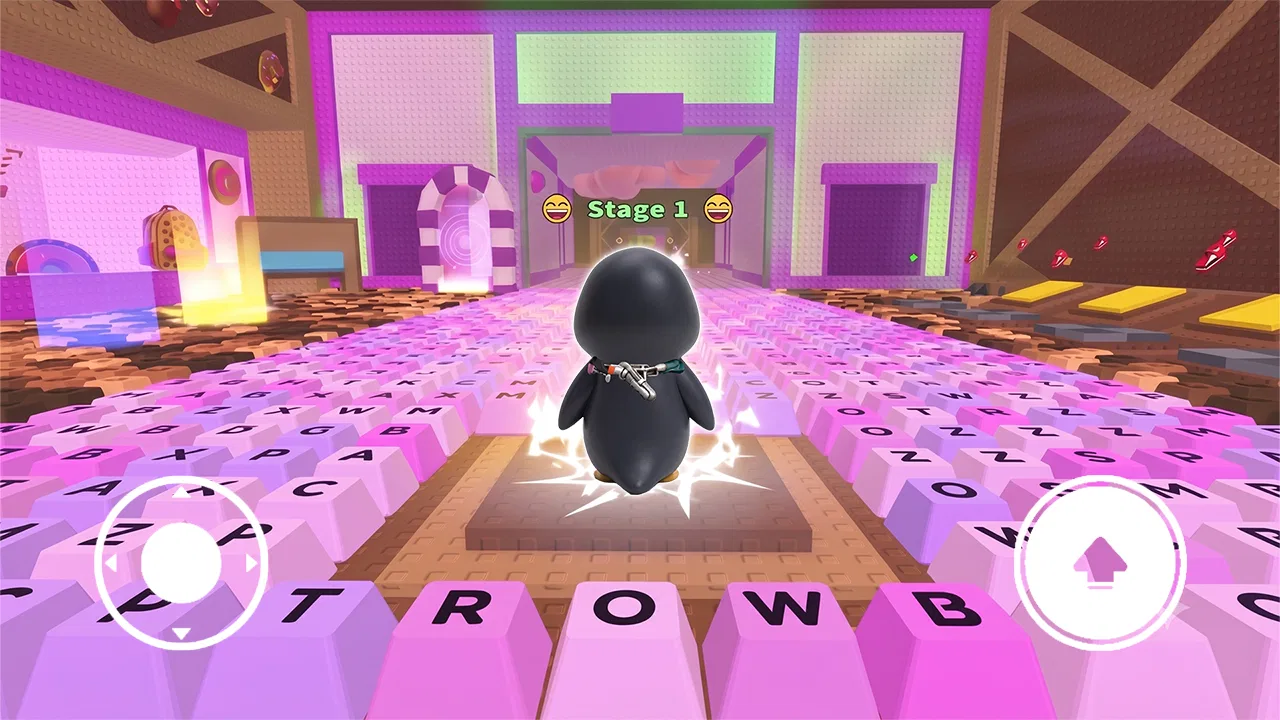
Keyboard Obby: ASMR Speed Run
- 4.6
- Rating
- 1.00M
- Installs
- Free
- Price

 Analysis by App-foxy
I tried Keyboard Obby: ASMR Speed Run as the kind of quick casual game that can pass between people on a shared phone without demanding a long session. Its basic idea is easy to understand: guide a character through sweet-looking parkour, run, jump, and escape while the game’s sound design adds an ASMR-style layer. That combination makes it approachable, but the real appeal is how quickly it turns into a test of timing. You can explain the goal in a few seconds, hand over the device, and let the next person attempt the same stretch.
That makes it especially suitable for a household where a phone or tablet is used by more than one person. I would not treat it as a deep multiplayer experience, because the game is better understood as a turn-based shared-device activity rather than a coordinated online game. One person plays while another watches, suggests when to jump, or simply waits for a turn. The short, direct format works well in those moments when nobody wants to commit to a large adventure or a complicated ruleset.
How Keyboard Obby fits into shared play
The strongest everyday use case is a brief break in a common room. Imagine two people waiting for dinner, travelling, or taking turns with the same device. One player starts a run, makes a mistake, and immediately wants another attempt. The observer can point out a jump, but the person holding the device still has to control the movement. That small separation between advice and execution creates a friendly challenge without requiring accounts, voice chat, or a second screen.
You May Also Like

 Blood Strike: 2.5 Anniversary
Blood Strike’s Loadouts Turn Every Drop Into a Tactical Gamble
A close look at Blood Strike’s custom loadouts: how fast access to signature weapons reshapes its battle royale rhythm, rewards preparation, and narrows the gap between fights.

 Pandora - Music & Podcasts
Pandora’s Music Is Easy to Start, but Harder to Recover
Pandora’s strength is its low-effort path from a seed to a station. Its weak spot is how much confidence it asks you to place in connection, setup, and quiet recovery.

 8 Ball Pool
 Is Built on Rivalries, Rematches, and Routine
A close look at the rivalries, rematches, shared routines, and unanswered safety questions that turn a quick pool match into a persistent mobile community.

 Samsung Music
’s Quiet Strength Is Playing What You Already Own
Its reach comes less from spectacle than from dependable access to a personal library. That simplicity is both the app’s strongest retention engine and its ceiling.

 AccuWeather: Weather Radar
AccuWeather Review: A Quick, Clear Forecast for Everyday Decisions
For everyday plans, the best forecast is the one you can understand quickly. AccuWeather makes rain timing, radar, and local conditions easy to act on, with a few trade-offs.

 Hill Climb Racing
Why Hill Climb Racing Still Turns Crashes Into One More Run
A tiny car, a bumpy hill and one more upgrade: Hill Climb Racing keeps resurfacing because its simple chaos makes every near-miss feel personal.
More From Our News Desk



I also found the game easier to share than many casual alternatives because its premise is visible on the screen. A new player does not need a long tutorial speech to understand that the path is dangerous and that movement must be timed. The sweet parkour presentation keeps the mood light, while the ASMR-oriented audio gives the experience a more focused feel than a completely silent obstacle course.
There is a useful trade-off here. The game is accessible enough for a quick handoff, but a spectator may become impatient if the same section is repeated too many times. Since the enjoyment comes from improving control and reacting to obstacles, the person watching is most engaged when they are also interested in learning the route. For a household, I would recommend agreeing on short turns rather than letting one player keep retrying indefinitely.
My practical tip is to use it as a five-minute challenge, not as background entertainment. The sound and movement are more noticeable when you are paying attention, and the parkour format rewards concentration. If everyone treats it as a small contest—who can get farther, who can recover from a mistake, or who can complete a difficult sequence with fewer retries—the simple design has more staying power.
What the controls demand from the player
The central skill is coordination between movement and timing. Running is only part of the task; jumping at the wrong moment can undo a good approach. That makes the game more demanding than its cheerful visual style might suggest. It is not difficult because it presents complicated menus or elaborate character systems. It is difficult because a familiar action becomes unforgiving when the timing is slightly off.
For a first attempt, I would encourage a new player to watch the rhythm of the course before rushing. The instinct in a speed-focused game is to move as quickly as possible, but speed without observation usually leads to unnecessary mistakes. A better workflow is to identify the next landing area, make the jump, and then prepare for the following obstacle. This is particularly useful when one person is coaching another on a shared device.
The ASMR sound angle also affects how I would use it. Some players will enjoy the satisfying audio feedback and find it helps them stay immersed. Others may prefer to lower the volume, especially in a quiet household or when several people are using the same room. Because the game’s appeal is partly sensory, the experience can change noticeably depending on the listening environment. I would keep the volume moderate and avoid assuming that everyone nearby wants the same sound level.
Another small but important point is hand position. On a phone, a player who grips the device too tightly can make quick movement feel less controlled, especially during repeated attempts. Holding the phone securely while leaving the active area unobstructed makes handoffs smoother. In a shared setting, it is worth passing the device carefully rather than interrupting someone in the middle of a jump.
Setting clear boundaries on a shared device
Keyboard Obby is free to play, which removes the most obvious barrier when several people want to try it. The game is also marked for Everyone, so its general presentation is suitable for a broad age range. That does not mean every child will find the timing equally easy, however. A young player may understand the goal immediately and still need help with patience, hand control, or accepting repeated failure.
Because the game is installed on a shared device, I would establish simple household rules before passing it around. Decide whose turn comes first, how long a turn lasts, and whether someone may restart after a mistake. These are not game features; they are practical arrangements that prevent a small casual title from becoming a source of arguments. The clearer the boundary, the more likely the experience remains enjoyable.
I would also separate game time from access to the rest of the device. A child asking for the phone to play does not necessarily need permission to browse, message, or open other apps. Keyboard Obby itself can be a contained activity, but the device may contain much more than the game. In a family setting, an adult should handle the broader device rules rather than assuming that an age label answers every question about supervision.
The game runs on Android devices using version 7.0 or later, so compatibility is fairly broad for older supported phones and tablets. Still, before planning a shared activity, I would check that the household device actually meets that requirement and has enough battery for repeated attempts. A game that is easy to pass around becomes less convenient when the device is already needed for calls, navigation, or another person’s work.
Coordination without pretending it is multiplayer
One of the most important distinctions is that shared play here means taking turns and communicating, not playing simultaneously through a connected session. That difference matters if you are choosing a game for siblings, friends, or a family gathering. Keyboard Obby can create conversation—“wait,” “jump now,” or “try the left side”—but the coordination happens around one player’s run.
That format can actually be an advantage for mixed-age groups. A more experienced player can demonstrate a section, then hand the device to someone learning. The learner can copy the pace without needing to manage a second character or worry about letting a teammate down. On the other hand, players looking for direct competition, shared objectives, or real-time cooperation should choose a game designed around those features instead.
I like using a simple observer role. The person not playing watches the next obstacle and gives only one short suggestion at a time. Too much coaching becomes distracting, particularly when the player is already concentrating on movement. This approach turns the game into a small coordination exercise: the observer must notice the course, while the player decides whether the advice is useful.
There is also a fair way to compare attempts. Instead of judging only who reaches the farthest, give credit for improvement, a cleaner jump, or a successful recovery. That keeps the experience welcoming for someone who has never played an obstacle game. It also prevents the fastest player from dominating the device simply because they already understand the timing.
Age, trust, and the role of the adult
The Everyone rating and cheerful casual presentation make the game a reasonable candidate for a child’s first shared parkour title. I would still play alongside a younger child at least once, not because the game appears complicated, but because the child’s reaction to failure tells you more than the label does. Some children enjoy repeating a jump until it works; others become frustrated quickly and would be happier with a less timing-sensitive game.
The same applies to trust on a shared phone. If a child is allowed to play independently, explain which part of the device they may use and where the game session ends. The important boundary is not only whether the content is age-appropriate; it is whether the child understands that the phone belongs to a wider household routine. A turn should end when agreed, even if the player is close to overcoming an obstacle.
For older children and adults, the game works better as a compact reflex challenge than as a long-term progression project. Its appeal depends on the satisfaction of movement, speed, and escape, not on a large social world or a complex collection of systems. Someone who wants a substantial campaign, character development, or deep customization will probably outgrow it quickly.
The developer is HIGAME GLOBAL, and the current version is 1.0. I would keep expectations realistic around that early, streamlined presentation: this feels like a focused casual experience rather than a broad platform with many layers. That is not automatically a weakness. It simply means the value comes from immediate play and repeat attempts, not from building a large personal profile inside the game.
How it compares with familiar casual choices
Compared with a standard endless runner, Keyboard Obby puts more emphasis on obstacle timing and the feeling of navigating a designed parkour route. An endless runner is often about surviving as long as possible while reacting to a constantly advancing track. Here, the sweet obstacle-course identity makes each jump feel more like a specific problem to solve. If you enjoy learning a sequence, this is the more appealing direction.
Compared with a puzzle game, the challenge is more physical and immediate. You are not mainly planning several moves ahead; you are trying to coordinate action with the moment on screen. That makes it a better fit for a quick break or a shared turn-based contest, while a traditional puzzle title may suit someone who wants a quieter experience with more time to think.
It also differs from a full platform adventure. Larger platform games usually provide more context, exploration, abilities, and reasons to return beyond mastering movement. Keyboard Obby is more direct. I would choose it when I want a short run and a clear challenge, not when I want a story-driven journey or a world to explore for an evening.
The sound design gives it another point of difference from many lightweight obstacle games. Players who enjoy tactile or satisfying audio may find the ASMR element makes repeated attempts feel less bare. Players who need silent play, dislike repetitive sound, or are sensitive to audio stimulation may prefer a conventional runner with simpler presentation. In a shared room, that preference can determine whether the game feels pleasant or intrusive.
Who should install it, and who should skip it
I would recommend it to someone who wants a free casual game that can be understood quickly, played in short bursts, and shared by passing one device around. It is a good match for families willing to set turn-taking rules, for friends comparing quick attempts, and for players who enjoy improving at jumps rather than collecting a large number of features.
I would be more cautious about recommending it to someone seeking a fully social experience. If your priority is playing together at the same time, communicating through built-in systems, or competing across separate devices, this is not the right category of game. The same is true for players who want a calm, low-pressure activity: the repeated timing demands may feel more stressful than relaxing despite the cute presentation.
It may also be a poor fit for a household where the device must remain quiet. The ASMR-style audio is part of the identity, but not everyone in a room will appreciate it. Muting or lowering sound can make sharing easier, although it may reduce one of the elements that distinguishes the game from a plain parkour runner.
My household verdict
With an average rating of 4.6 from around 2.1 thousand ratings and more than a million installs, the game has clearly attracted a substantial audience for a compact casual release. Those figures do not replace personal taste, but they fit my impression that its immediate premise is easy for people to try. The free price also makes a spontaneous shared-device test simple: there is no purchase decision standing between curiosity and the first run.
My final view is positive, with a specific recommendation rather than a universal one. I would keep Keyboard Obby on a shared Android device when the household wants a quick, age-friendly challenge that encourages watching, advising, and taking turns. I would not present it as a substitute for a deep platformer or a genuine multiplayer game. Its best quality is its narrow focus: run, judge the timing, jump, recover when possible, and try again.
The most enjoyable setup is a quiet enough space to notice the sound, a clear turn limit, and one person willing to learn the course rather than simply rush. Under those conditions, Keyboard Obby: ASMR Speed Run becomes more than a disposable tap-and-play title. It becomes a small coordination game for the household—simple to start, easy to explain, and just demanding enough to make the next attempt feel worthwhile.
FAQs for Keyboard Obby: ASMR Speed Run
01What is Keyboard Obby: ASMR Speed Run?
Keyboard Obby: ASMR Speed Run is a casual obstacle-course game built around fast movement, timing, and satisfying keyboard-themed visuals. You guide a character through short platforming challenges, avoid traps, and try to reach the finish as quickly as possible. Its simple controls make it easy to start, while increasingly difficult levels test reaction speed and precision.
02How do you play Keyboard Obby: ASMR Speed Run?
Gameplay is based on moving through an obstacle course while jumping, changing direction, and avoiding hazards. The controls are designed to be straightforward, so most players can understand them after a short practice run. Success depends mainly on observing the course, choosing the right moment to move, and repeating difficult sections until your timing becomes more consistent.
03Is Keyboard Obby: ASMR Speed Run suitable for children?
The game generally offers simple, colorful, non-realistic gameplay that can appeal to children and casual players. However, parents should still check the current age rating, advertising content, and any available purchase options on the relevant app store. Difficulty can also become frustrating for younger players, especially when later stages require quick reactions and repeated attempts.
04Does Keyboard Obby: ASMR Speed Run require an internet connection?
Many obstacle-course games of this type can be played during short offline sessions, but certain features may depend on an internet connection. Advertisements, updates, leaderboard functions, rewards, or other online services may not work without connectivity. Before downloading, check the store listing and test the game in airplane mode if offline access is important to you.
05Is Keyboard Obby: ASMR Speed Run free to download?
Keyboard Obby: ASMR Speed Run may be available as a free download, but free access does not always mean an entirely ad-free experience. Games in this category commonly use advertisements and may include optional purchases, such as removing ads or unlocking bonuses. Review the store page carefully before installing, particularly if the device is used by children.
Pros
- Simple controls make it easy to start playing immediately.
- Short obstacle courses are ideal for quick gaming sessions.
- ASMR-style sounds make movement and collisions feel satisfying.
- Bright visuals and clear platforms are easy to follow.
- Progression encourages players to improve their completion times.
Cons
- Repeated obstacle patterns can make later runs feel predictable.
- Fast sections may be frustrating on smaller phone screens.
- The game may become repetitive after extended play sessions.
- Some levels rely heavily on timing rather than strategic choices.
- Ads may interrupt the experience or slow down progression.

Keyboard Obby: ASMR Speed Run
Gallery